Let’s stop pretending we’re snowflakes. Everyone in the creative field collects references, borrows rhythms, and reverse-engineers layouts. That’s normal - it’s how visual culture evolves. What’s not normal is when “inspiration” turns into a pixel-for-pixel karaoke performance you can’t defend to a client or a lawyer.
This is fair use for designers in real life: not theory, but a practical way to stay fast, original enough, and legally clean.
If you work with visuals and want to use references, moodboards, and templates without crossing copyright lines, this guide gives you a repeatable workflow grounded in fair-use principles and professional practice.
I’ve led teams for years and watched careers wobble over this. You don’t need 300 studies - you need a system that keeps you quick, clear, and legally safe.
Below is the exact workflow I’d teach a junior sitting next to me on deadline day.
The honest truth about “inspiration”
There’s no design without influence. The question is: what did you transform? If your result preserves the same structure, the same “story beat,” and the same surface treatment, you’ve recreated - not created. (I call those the Three Deltas: structure, story, surface. Change at least two.) When you can point to your own grid, typographic hierarchy, and brand cue that replaced their “hero move,” you’re on safer ground.
Also: if you can’t show me where the source came from and what you’re allowed to do with it, it doesn’t go in the deck. Hard rule.
And if you’re the type who just sits there “waiting for inspiration,” go read Still Waiting for Inspiration? Meet Creative Stock and then come back to actually work.
The legal baseline: fair use for designers (you actually need to know this)
Read one official thing: the fair use guide from the U.S. Copyright Office. It won’t give you magic numbers (“30% changed = safe,” that myth needs to die), but it will show you the factors that matter - purpose, nature, amount, and market effect. Translation: context and transformation are the ballgame.
Since you’re shipping digital work, design it so people can read it. The WCAG accessibility guidelines call for specific contrast ratios (4.5:1 for body text, 3:1 for large). If your “innovative” colorway fails that, the feedback you’ll get isn’t “bravo,” it’s “redo.”
Fair use for designers lives exactly here: you know the rules, you document references, and you can explain why your result isn’t a repackaged copy.
How to Use Design References Legally: A Five-Step Workflow
1) Define the job to be done.
Where will this live? What’s the smallest size it must survive? Who’s the audience? If you can’t answer those, you’re mood-boarding a fantasy.
2) Collect references legally and log them.
Use sources you can defend and keep a trail: file, link, license terms, date. If you can’t trace it, don’t touch it. If you need raw materials quickly, start with Search and pick a base asset you know is licensed. You’re not cheating; you’re being a professional.
3) Abstract the reference.
No, not “copy but nudge.” Strip it down: what’s the grid? What’s the type ramp? Where’s the tension in the composition? Extract principles - not shapes.
4) Rebuild from primitives.
Reconstruct with your own grid, your own type scale, your own brand elements. Swap their signature flourish for your brand’s archetype: e.g., keep the diagonal energy but express it via your logomark’s 18° angle and color system.
5) Reality-check in context.
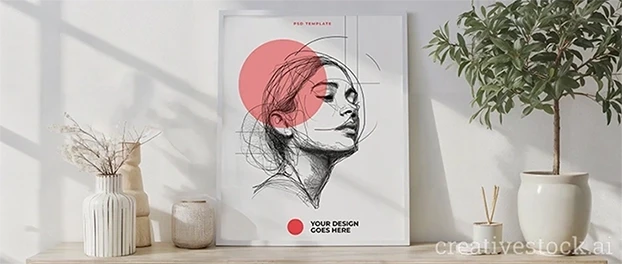
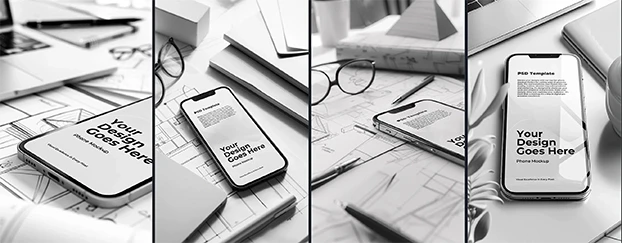
Preview it like it’ll ship. That means one clean layout plus a believable scene. Drop the layout into a mockup to check how the hierarchy holds up in a hand, on fabric, or under glare. If you’re working with framed visuals or interior scenes, test it in a realistic frame environment like this interior AI frame mockup and see if it still reads at a glance. If the deliverable is structural, build it on a template with sane spacing and typographic defaults - then preview it. If it breaks at thumbnail size or arm’s length, it’s not “bold,” it’s broken.
How to Tell if Your Design Remix Is Transformative Enough
Run the Three Deltas:
- Structure: Is your grid, spacing, and rhythm independently conceived?
- Story: Did you shift the narrative beat (e.g., from “mysterious luxury” to “warm craft”)?
- Surface: Did you change the visible tactics - type pairing, color logic, textures, lighting?
If you can’t defend two of three with a straight face, you’re too close. Start over or simplify until your reasoning is obvious even to a grumpy art director. Fair use for designers is not a loophole; it’s your ability to show: this is my structure, my story, my surface.
Speed Without Stumbling
Templates and mockups are scaffolding, not crutches. Good scaffolding does three things:
- Bakes in proportion and readability (type sizes that don’t require a microscope).
- Reflects real-world physics - folds, fabric stretch, reflections - so you don’t sign off on a fantasy render.
- Shrinks decision fatigue. You’re free to think about message and brand, not babysit gutters all afternoon.
If “fast” for you means tossing unlicensed images into a layout and praying, you’re not fast - you’re gambling. If you want a baseline that doesn’t fall apart, start building systems on reusable structures like high-quality templates from a dedicated library.
Feedback That Prevents Rework (Steal My Checklist)
When I review drafts, I don’t say “make it pop.” I ask:
- Can I read the primary message at 320 px wide? (Mobile reality check.)
- Does body text meet a sane contrast threshold? If your colors fight the content, you’re not being edgy, you’re being unreadable.
- Does the composition survive at arm’s length? (Pin your mockup on the wall, step back two meters.)
- Is there a single, decisive focal point? (Not four.)
- Is the license trail documented? (File note or it didn’t happen.)
One layout, one context preview, one meaningful variant. That’s the whole review. Anything else breeds “what if” purgatory.
When to Walk Away from a Reference
- If the concept only works because of their signature move, kill it.
- If the legal trail is murky, kill it.
- If your client picked a moodboard to avoid paying for thinking, set a boundary and explain the risk using the same factors you saw in that fair use guide - there are no safe percentages, just context and transformation.
Then extract the principle you liked (e.g., “asymmetry that guides the eye to a CTA”) and rebuild it with your brand’s language.
A Note on AI (Use It Like a Pro, Not a Tourist)
AI is great for exploration. It is not a license fairy. Use it to sketch variations, then rebuild with proper type, spacing, and proportion. Keep chain-of-custody notes: prompts, sources, licenses. Give the output a human edit pass - fix edges, regulate hierarchy, and sanity-check color/contrast. If it still looks like a fever dream at 100%, delete it.
Quick FAQ: Fair Use for Designers
Can I copy a design if I change 30%?
No. The “30% rule” is a myth. Fair use depends on purpose, context, transformation, and market impact - not arbitrary percentages.
Can I use Pinterest or Dribbble images in client work?
No, unless you have explicit licensing. You can reference them for mood or direction, but you cannot reuse them as assets.
How do I know if my remix is legally transformative?
Apply the Three Deltas: structure, story, surface. If you can defend at least two changes convincingly, you’re in safer territory.
Is using templates and mockups still considered original design?
Yes - if you use them as scaffolding and apply brand-specific structure, hierarchy, and visual language. Templates are starting points, not finished products.
If you want the deeper “why”
If you want the philosophy behind this workflow - why reliable scaffolding, realistic context, and licensed assets make teams faster and approvals calmer - read Creative Stock Is Not Magic - It Just Works, It expands on the same method so you can standardize it across a team, not just survive one deadline.
TL;DR (Pin This)
- Everyone borrows. Professionals license, transform, and document.
- Use the Three Deltas to avoid copycat territory.
- Always preview in real context.
- Evaluate using objective checks (contrast, legibility, thumbnail test).
- Keep a clean paper trail; fair use relies on transformation, not percentages.
Final step (if you’re actually shipping this week)
Stop hunting for “free inspo” you can’t defend. Start from licensed building blocks, keep a clean trail, and use the same workflow every time. When this process starts paying for itself and you’re ready to standardize it across a team, pick a plan on Pricing and stop gambling with your work.