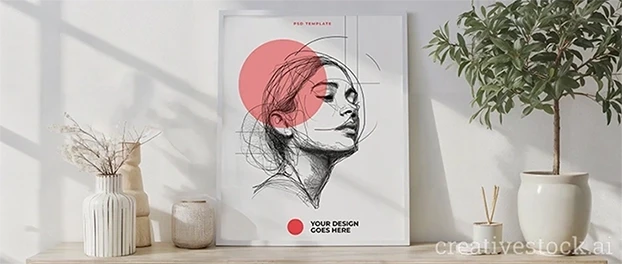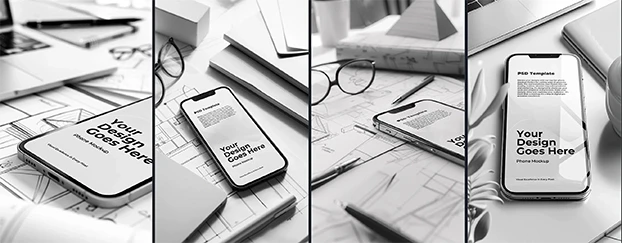

Let’s be honest from the jump: the design industry is having an identity crisis. One part adapts, ships, iterates. The other clings to nostalgia - believing craft is defined by suffering inside Photoshop at 3 a.m. Traditional stock platforms enabled that delusion by burying us under endless rows of mediocre images, inconsistent lighting, impossible masking jobs, and assets that needed more rescuing than using.
The shift came with a new generation of creative stock platforms that don’t pretend to be magic - they simply eliminate waste. AI accelerates production; designers refine the output. The result is a library of high-resolution mockups, customizable templates, and ready-to-use assets that behave like tools, not placeholders. Senior truth: clients reward speed, consistency, and coherence. Romanticism doesn’t pay invoices. If you want to see the system in one place, start from the Creative Stock home and work forward from there.
The old stock model was a time sink. The new model eliminates the leak.
Most designers secretly know how much time is wasted navigating traditional libraries. Everything looks “almost right,” which means nothing is actually right. You hunt, you tweak, you composite, you color-correct, and somehow the final image still looks like it was lit with a streetlamp.
The modern creative stock approach solves that by delivering assets pre-aligned in lighting, geometry, and realism - optimized for instant design previews and time-saving workflows. Your mockup doesn’t require CPR before it’s client-ready.
Industry research aligns with this shift. The Nielsen Norman Group notes that AI design tools have officially entered their “workhorse phase” - used for production, not novelty. That means practicality is now the standard.
For a real-world look at how this functions, explore the organized mockup collection - a library designed to remove friction, not add to it.
AI speeds up the process - human designers finish the job
Pure AI output rarely crosses the threshold of professional consistency. It’s fast, but brittle. That’s why the strongest creative stock systems rely on a hybrid model: AI generates, designers refine. Humans correct typography drift, stabilize shadows, fix warping, smooth depth inconsistencies, and remove uncanny elements before the asset ever reaches your screen.
The outcome is agency-grade realism without the agency-grade invoice. Clients notice the difference - even if they can’t articulate it, they can definitely feel it.
Industry-wide data reinforces this. According to Adobe, creative professionals are leveraging generative AI to increase quality, not replace expertise. AI automates the repetitive. Humans preserve the taste.
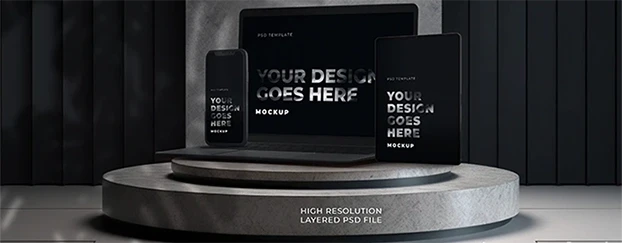
One of the clearest examples of this hybrid quality can be seen in the iPad Tablet Mockup - AI Cards Shadow. This isn’t “AI art.” It’s a polished, stable, presentation-ready asset built for real brands.

From “can we see 12 options?” to “approved” - in one day.
Blank-canvas paralysis stops existing when your foundation is strong. With creative stock assets, you can assemble three distinct creative directions in under an hour, not three days.
Pitch boards, hero graphics, packaging tests, social variants - everything builds faster when the base elements are consistent. That consistency is exactly why modern teams rely on this kind of system for clean A/B testing. When mockups share the same lighting, environment, and structure, the only variable becomes the idea. And that produces cleaner data.
The team at Vizit underscores this in their analysis of predictive image analytics versus traditional A/B testing: less noise equals better insights.
If you want to test workflows without spending a cent, start with the free library and see how quickly you can assemble production-ready concepts.
What a normal workweek looks like when you stop fighting your tools
Monday:
Pitch board with 8 polished directions built in 45 minutes using AI-enhanced mockups and customizable templates.
Wednesday:
Packaging tests created using stable, realistic mockups - no re-lighting, no re-masking.
Friday:
Campaign rollout finalized with assets from the templates library - IG stories, banners, holiday promos, all aligned without restarting from scratch.
And whenever you’re in a rush, the platform’s search function finds the exact device angle, category, or visual style in seconds.
The silent SEO advantage designers ignore until it's too late
Strong visual consistency isn’t just good design - it’s good SEO. Search engines favor pages and catalogs that maintain predictable hierarchy, clean structure, and thematic coherence.
When your visuals align - especially across landing pages, product mockups, and campaign assets - you’re building the kind of topic clusters Google respects. It’s the same principle explored earlier in Creative Stock Is Not Magic — It Just Works: frictionless systems outperform improvisation.
The asset model behind creative stock supports this naturally. It provides the consistency that search engines - and users - reward.
Final verdict from a slightly grumpy, fully employed senior designer
If your ego insists every asset must be artisanal, go book a photoshoot and invoice bravely. But if you work with real deadlines, real clients, and real expectations, you already know the truth: the new standard is built on reliability, not theatrics.
Nothing about this is “AI taking over creativity.” It’s the opposite. It’s AI eliminating the waste so you can spend time on the part clients actually pay for - taste, judgment, and execution.
Do less busywork. Do more real work. And when you’re ready to scale without setting your budget on fire, choose a plan on the Pricing page and move like a professional.